IP Audit
A deeper review of the intangible assets the business relies on: what exists, who owns it, how it is protected, and what needs fixing.
What It Is
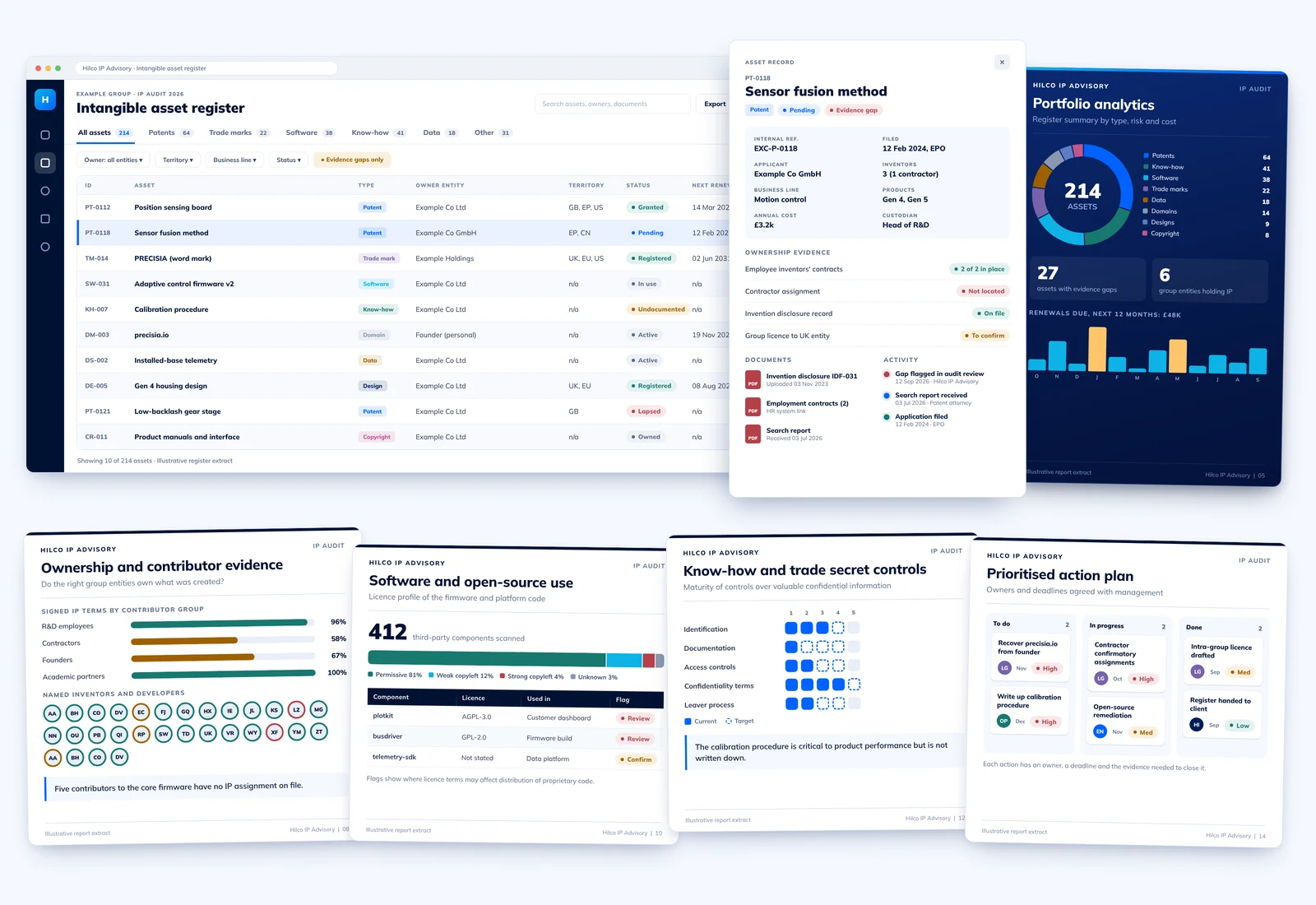
A structured investigation of the full intangible-asset position, not just the registered rights. Depending on the business, that typically spans patents and trade marks, software and source code, data, algorithms and models, technical and operational know-how, brands and domains, and the licences and commercial agreements that sit around them. The work covers ownership chains (often messy in businesses with M&A history, founder transitions, or IP created by contractors and collaboration partners), the status and coverage of registered rights and their alignment with what the business actually sells, governance over trade secrets and know-how (who has access, how it is protected, what happens when key people leave), key-person dependencies, and the documentary trail behind each significant asset. Where questions of legal validity or enforceability arise, we bring in patent attorneys or legal specialists rather than opining ourselves.
IP Discovery establishes the intangible-asset picture quickly: what exists, what matters commercially, and where the gaps and opportunities are. The IP Audit is the deeper counterpart, investigating ownership, protection, dependencies, and remediation in detail.
Where the portfolio warrants it, the audit also includes a portfolio evaluation: a structured view of whether each right should be maintained, developed further, divested, or allowed to lapse, grounded in the company’s commercial direction and the cost of maintenance. Portfolios accumulate assets over time without systematic re-evaluation, and the maintenance cost often outweighs the commercial value of what is being maintained.
Why Would You Need It
Three common situations. First, ongoing governance: a company wants to verify that its IP estate is in good order, often triggered by a leadership change, a board concern, or following an acquisition. Second, pre-deal preparation: a company anticipating a transaction in the next 6 to 18 months wants to identify and fix issues quietly, before a buyer’s diligence team surfaces them under deal pressure. Third, cost: the IP budget has grown to a level the business is questioning, often a sign that portfolio decisions are happening by default rather than design.
The pre-deal use case is materially different from a buyer-side Pre-Deal IP Screening. The Audit has more time, more access, and more focus on remediation. The Screening is fast-turnaround, time-pressured, and focused on red-flagging issues for the SPA.
A report prioritised by likely commercial impact, typically covering the intangible-asset register, ownership and control findings, protection gaps, key-person and know-how risks, governance recommendations, and a practical action plan with remediation prioritised and timed. Where the portfolio warrants it, an asset-by-asset view of what to maintain, develop, divest, or let lapse, with the associated cost savings. For pre-deal engagements, the report is structured to be useful both for internal fix work and for the eventual data room.
Where This Sits In The Broader IP Work
On the IP Operations side, the Audit keeps the estate sound while Innovation Harvesting keeps it growing: the Audit catches historic gaps, Harvesting catches future ones. On the IP Transactions side, the Audit is a foundation for sell-side readiness: commissioned with more time and more access than a buyer’s diligence team will have, and focused on fixing rather than flagging. It is typically the first step of the ExitIP sequence.