Patent Box
Reduce corporation tax on qualifying patent-derived profits to 10%. From identifying the IP to supporting the claim, we run the process end to end.
Patent Box Enablement
We help businesses assess their Patent Box opportunity and prepare the IP evidence supporting the claim. This can include mapping existing patents to products, services or processes, identifying patentable innovation where protection is needed, and coordinating the work with patent attorneys and tax advisers.
The UK Patent Box regime reduces the corporation tax rate on profits derived from qualifying IP to 10%. Capturing the benefit requires identifying which IP qualifies (patents granted by the UK IPO, EPO, or specific other authorities, owned or exclusively licensed by the company, with the development conditions met), connecting the qualifying IP to the company’s products and revenue, and documenting the analysis to a standard that supports the tax claim.
Patent Box claims often require detailed analysis of the underlying patents, ownership and licensing arrangements, development activity, and the connection between the patented technology and the company’s products and revenue. They also require several specialisms working together: IP analysis, patent drafting, and tax. Hilco provides IP analysis, commercial mapping, evidence review and coordination. Patent attorneys advise on protection and filing. Tax advisers handle eligibility, calculation, election and the tax return. One engagement, one point of contact, and the heavy lifting done for you.
A granted patent is the entry ticket, but not holding one yet is not the end of the conversation. For profitable companies with patentable innovation that has never been protected, we identify the patentable subject matter and manage the route to protection, coordinating the patent attorneys who draft and file. Profits earned while a patent application is pending can be claimed once the patent is granted, for up to six years of the pending period, so the earlier the filing, the more of the benefit is preserved.
When This Matters
- Companies with significant taxable profit, an active R&D function, and existing or potential patent protection on the products generating the profit.
- Profitable companies with patentable innovation that has not yet been protected. Identifying the patentable subject matter is often the first step to accessing the regime at all.
- Software and deep-tech companies with R&D-driven products, where innovation that could be patentable often isn’t.
- Tax advisers who have flagged Patent Box as a possibility for a client and want specialist IP input to assess and support it.
- PE-backed portfolio companies where Patent Box has been identified as a value-creation lever.
How The Engagement Works
The work runs in two stages of a single engagement.
Feasibility assessment. A focused review of the company’s IP position, R&D activity, taxable profit, and revenue streams, producing a view on whether a claim is worth pursuing. It addresses the core questions: is there qualifying IP that the company owns or exclusively licenses, does the development story support a claim, does the IP connect to the products and revenue, and is the likely benefit material enough to justify the work. Typically a matter of weeks rather than months. Where the answer is yes, the work also estimates the likely benefit and identifies any preparatory work needed before the full claim. Where the company has no granted patents yet, the feasibility work identifies the patentable subject matter and the route to protection.
Claim support. Where the feasibility is positive, we produce the IP-side analysis behind the claim, typically covering the qualifying IP register, the mapping between the qualifying IP and the company’s products and revenue, and the supporting documentary trail. Structured to be defensible to HMRC under enquiry.
You can elect into the Patent Box while a patent application is pending. The election deadline is generally two years after the end of the first accounting period you want it to cover. Once a qualifying patent is granted, eligible profits earned since the qualifying application date, up to six years before grant, may be included in the calculation for the year of grant, subject to the relevant elections and eligibility conditions. Waiting for grant can mean losing relief on earlier profits. We help prepare the supporting IP evidence and coordinate with your tax advisers on timing.
Throughout both stages, we run the process: the IP analysis is ours, the patent drafting sits with the attorneys we coordinate, and the claim is prepared with Patent Box tax specialists or your existing tax adviser. Your team’s involvement is kept to what only your team can provide.
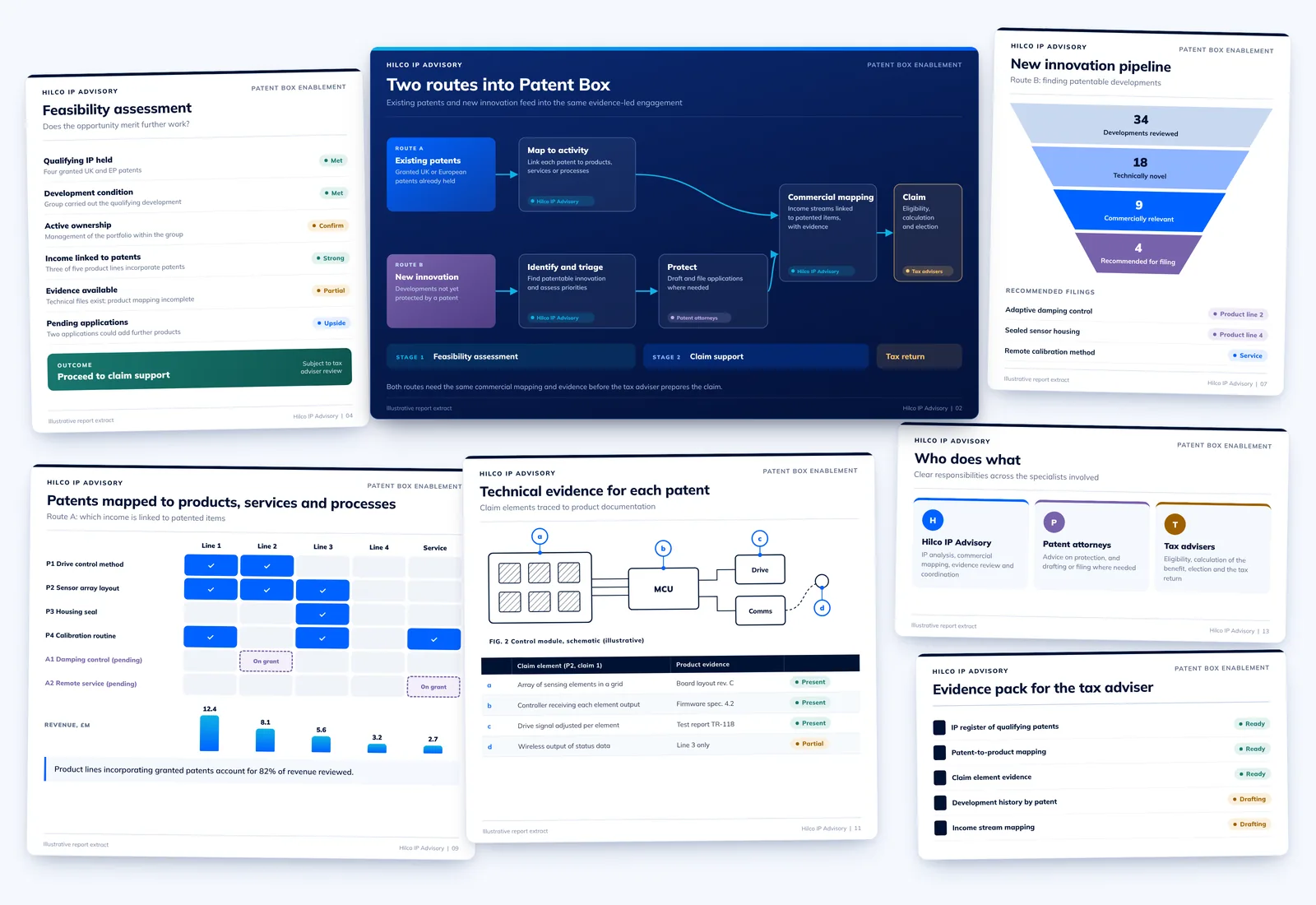
From the feasibility stage, a short report with a recommendation: the qualifying IP picture (with gaps identified), the connection to products and revenue, the estimated benefit range, the documentary readiness picture, and recommended next steps. Structured for a commercial reader as well as the tax adviser.
From the claim stage, the IP-side analysis the tax adviser uses to construct the claim, typically including the qualifying IP register, the mapping to products and revenue, the supporting documentary trail, and a position summary.
Where This Sits In The Broader IP Work
Often triggered by a tax adviser, or by leadership reading about the regime. IP Discovery provides the foundational IP picture and is typically where the work starts. Innovation Harvesting strengthens the future qualifying base by capturing innovation that has not yet been filed, with the Patent Box benefit following as filings proceed to grant. Works alongside the client’s tax adviser throughout.